The issue: avoiding designing the wrong answer
“Our offices are half empty” may point to a floor-area problem, but it can also hide an inconsistent hybrid policy, an unsuitable booking system, poorly distributed teams, or a lack of meeting rooms or focus spaces. A floor plan does not fix the organisation: it supports it once it has been clarified.
Workplace strategy (the strategy for working environments and ways of working) links work, organisation, real estate and space. It answers six questions: how do we actually work? What is not working? What spaces do we need? Which working model should we adopt? How do we put it in place? How do we measure whether it works?
The situations that trigger it
- A lease is coming to an end: stay and reorganise, renegotiate the floor area, or leave. The decision is made on compared scenarios, not on a viewing.
- An under-used head office: actual attendance, its peaks and its variability by team show whether floor area is the issue.
- Growth, a merger, a reduction in headcount: future headcount is expressed as explicit assumptions, with several trajectories.
- A hybrid working policy to build or correct: why come to the office, which work requires being on site, which team days.
- Several sites: the role of each site, common standards, local adaptations.
The method
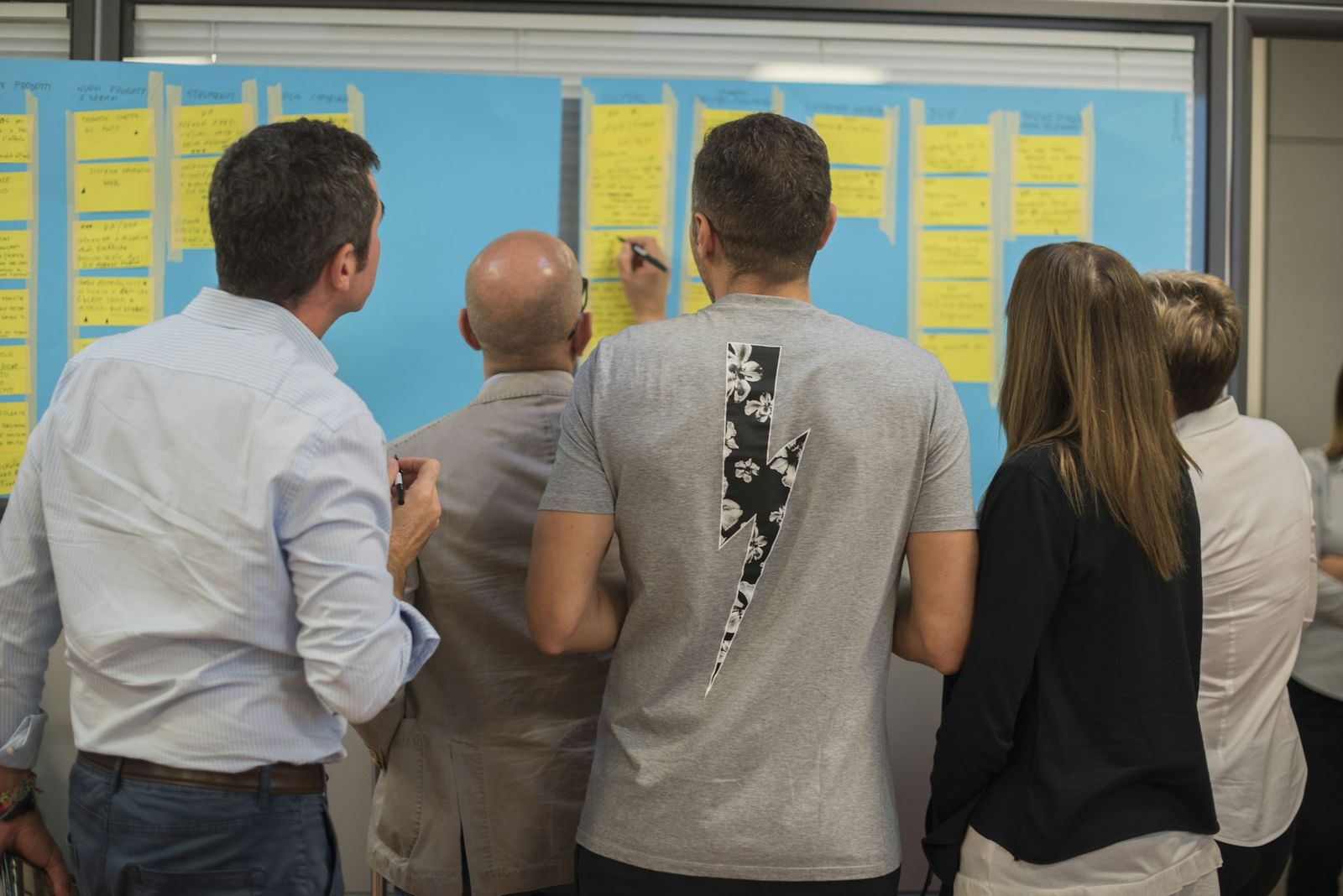
1. Understand how work is really done
Interviews with senior management and managers, team workshops, observation, a questionnaire, and the data available: badges, bookings, counts, sensors where applicable. Usage data is aggregated and is never used to monitor individuals; collecting it requires employees to be informed beforehand and, in companies with at least 50 employees, consultation of the works council (CSE) on the means of monitoring activity (French Labour Code, art. L1222-4 and L2312-38).
We always distinguish attendance (who came in), occupancy (how many people are present), utilisation (whether desks and rooms are actually used) and capacity. And we look at the peak, the median and the variability, not just the average.
2. Align the organisation and the space
Is the problem spatial, organisational, managerial, technological, cultural, real-estate-related, or a combination? We build activity profiles (focused work, collaboration, confidentiality, client reception, mobile working) from observed activities, not from marketing personas.
3. Build and compare scenarios
Depending on the context: optimise the existing space, transform it, relocate, or combine a head office with satellite sites. Each scenario is compared on the same template: rent and service charges, works, furniture, IT and audiovisual, relocation, fees, contingencies, timeline, risks, effects on teams, carbon.
What you receive
- Usage diagnosticattendance, occupancy, utilisation, peaks, pain points
- Activity profilesby team, with their space requirements
- Working principlesattendance, hybrid rules, team spaces
- Compared scenarioscosts, timescales, risks, expected effects
- Test fitdoes the space programme fit on the floor?
- Roadmapdecisions to be made, sequence, timeline
An office design does not guarantee “+20% productivity”. Expected effects are presented as assumptions, measured after move-in, and kept distinct from observed results.
Getting started: the workplace diagnostic
A short, fixed-fee engagement that answers three questions: what is really happening? What is the real problem? What needs to be decided next? It can stop there, or lead on to briefing, design and construction.
Frequently asked questions
Do you need to install sensors to measure occupancy?
Not necessarily. Observation counts over several weeks, together with booking and badge data processed in aggregate, are often enough. Any system that collects personal information about an employee must have been brought to that employee's attention beforehand; in companies with at least 50 employees, the works council (CSE) is consulted on the means used to monitor activity.
How long does a diagnostic take?
It depends on headcount, the number of sites and the data available. A data-collection period of several weeks is needed to see peaks and variability; the exact duration is set in the proposal for the engagement.